


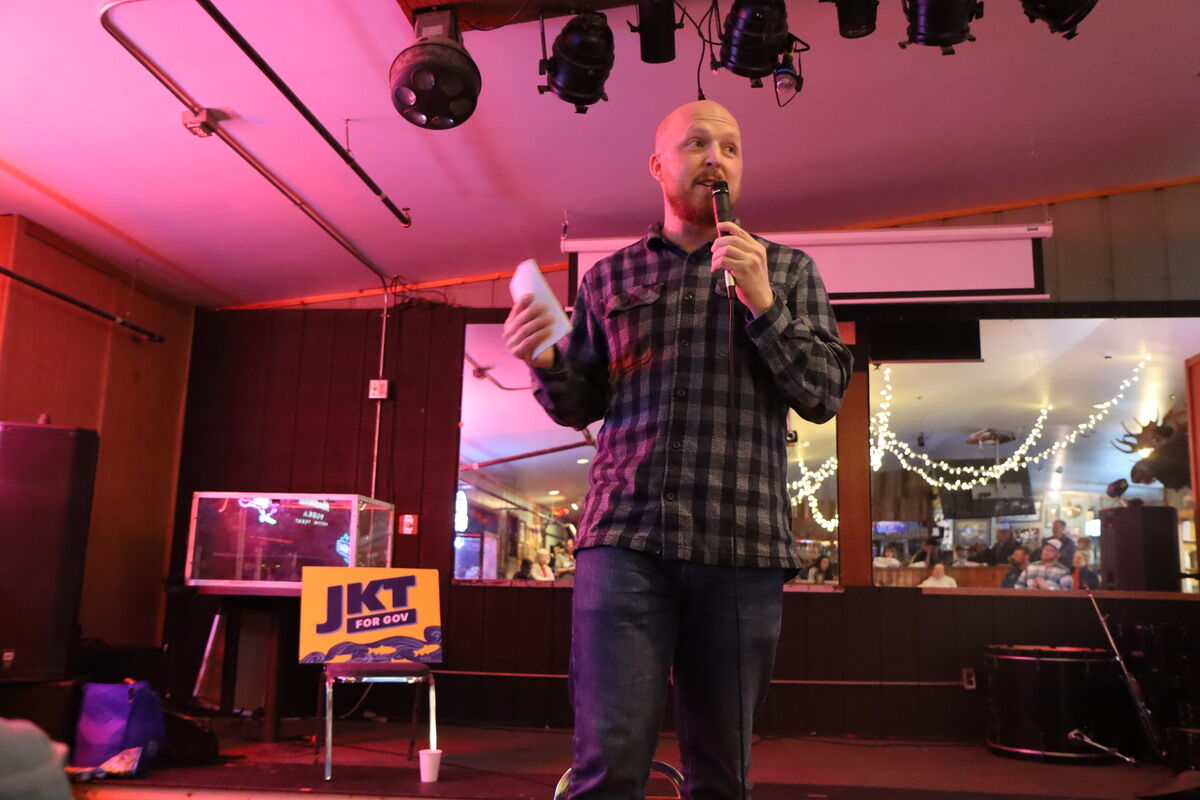
Jonathan Kreiss-Tomkins addressing a crowd of Petersburg residents at the candidate meet and greet in Kito's Kave on July 5, 2026.
From 2013-2023, Jonathan Kreiss-Tomkins represented Alaska's 35th district, including Petersburg, in the Alaska House of Representatives. Kreiss-Tomkins returned to Petersburg on July 5, this time as a candidate for governor. He held a meet and greet at Kito's Kave where he chatted with community members and delivered a speech.
Kreiss-Tomkins grew up in Sitka. At the age of 13 he developed a passionate interest in politics. And by age 14, he launched a statewide grassroots campaign for then presidential candidate Howard Dean.
"Even as a 13 year old, I could tell that [politics], unlike baseball and the Boston Red Sox, was a way to change the course of the world, and make your community, whether a national level or a local level, hopefully better, and I wanted to engage politics as this medium for positive change," Kreiss-Tomkins said.
Kreiss-Tomkins went to college at Yale, but a semester before he finished his degree, he dropped out to run for the Alaska House of Representatives in his home district.
"A fair share of our oil and gas resource ... is the issue that motivated me to drop out of college and run for legislature against an eight-year incumbent back in 2012," Kreiss-Tomkins said.
His district's Republican incumbent Bill Thomas had voted for Senate Bill 21 (SB 21), the oil industry tax cut that Kreiss-Tomkins deeply opposed and believed most Southeast Alaskans opposed too. He knocked on every door he could and defeated Thomas by 32 votes.
Once in the legislature, Kreiss-Tomkins fought against SB21.
"Of the 17 candidates in [this race for governor] I'm the only one who voted against [SB 21]," Kreiss-Tomkins said. "I'm very proud of that vote, and I think it's clear from the diminished oil and gas revenue that Alaska gets that we're sort of due to revisit the tax system."
Kreiss-Tomkins went on to serve five terms in the House.
"Representing mixed political turf, including a lot of conservatives, a lot of Republicans, and earning their trust and respect and support and votes, I think was a great way to sort of learn the ropes in order to be a statewide candidate," Kreiss-Tomkins said.
In the House, he helped build the bipartisan House Majority Coalition. He and his allies across the state recruited moderate Republicans, Independents, and Democrats to run for office – candidates who shared a problem-solving vision. By 2016, they had elected 25 members to the House and formed the bipartisan coalition majority that still governs the House and has been joined in recent years by a similar coalition in the Senate. He says no other legislature in the country can boast of the same model of bipartisan governance.
He wants to bring the same cross-partisan approach to an executive branch he says has lacked it. He pointed to Governor Mike Dunleavy's first proposed budget in 2019 – which he said would have cut the University of Alaska by 40%, slashed funding for the commercial fisheries division, and more – and argued the House coalition's one-vote majority was the only thing that stopped it.
Despite entering the Alaska legislature the same year as Dunleavy and having plenty of respect for him as a person, Kreiss-Tomkins remains critical of Dunleavy's tenure as governor.
He argues Alaska is worse off than it was eight years ago "everywhere you look, from our public schools to our ferry system to the Board of Fish," and he ties much of that to the governor's office.
"He's the most unpopular governor in the country, according to Morning Consult polling, and to me that's heartening, that a strong majority of Alaskans see what, at least I see," Kreiss-Tomkins said. "That's what this campaign is all about, is trying to reverse the Dunleavy decline that Alaska has endured these last eight years, and try to bring... governance of problem solving and finding common ground."
In his address to Petersburg residents, Kreiss-Tomkins emphasized three priorities: public education, cost of living, and fisheries.
As the Representative for multiple commercial fishing communities, including Petersburg and Sitka, he said he worked to champion the industry as a member of the House fisheries committee for all 10 of his years in office.
"I was endorsed by United Fisherman Alaska throughout my time in the legislature," Kreiss-Tomkins said.
Improving the board of fisheries sits high on Kreiss-Tomkins priority list.
"The Board of Fisheries, are in one of the worst places they've ever been since statehood, and the principle of having a balanced Board of Fish, which is a principle that has existed in the state since the Board of Fish was created, is out of balance, and that is a direct consequence of the appointments this governor has made to the Board of Fish, so we want to change that equation."
On education: He vows to reinvest in Alaska's public schools.
"Years of cuts have really hollowed out this core institution that is in each of our communities across Alaska. Teachers are leaving the profession, classes are being cut, schools are outright closing across the state. We want to reverse that," Kreiss-Tomkins said.
"Right now ... teachers in Alaska – we have a 21%... turnover rate with Alaska teachers. Nationally, that is 7%," Kreiss-Tomkins said.
To help keep teachers in Alaska, Kreiss-Tomkins pointed at the current retirement system.
"One of my priorities is bringing back a defined benefit system for retirement," Kreiss-Tomkins said.
Alaska's defined benefit pension system for teachers and public employees was discontinued in July of 2006. Instead now, a 401(k)-style defined contribution plan is in place.
"If you're serving as a teacher, to some extent it is almost financially irrational, it's almost financial self-harm to be in that position relative to entering another profession or just leaving the state to do the same thing."
Earlier this year, lawmakers passed House Bill 78 which would bring back a modified version of the defined benefit pension and grant public workers and teachers a retirement pension check. The bill was vetoed by governor Mike Dunleavy, and the vote to override the veto narrowly failed.
Asked about the governor's reliance on the veto: Kreiss-Tomkins told the crowd in Petersburg that his approach to using the veto would be very different from Dunleavy's.
He would not line-item veto education funding, and would not veto bills that passed the Legislature unanimously.
"I'm not going to veto bills without explanation or consultation with the people who sponsored the bill and the parts of Alaska that are affected by the bill," Kreiss-Tomkins said.
On affordability: Alaska has now seen 13 straight years of negative net migration, and ranks among the highest costs of living in the country.
Improving affordability is a key priority for Kreiss-Tomkins when it comes to keeping people in the state. Lowering costs is one of the primary focuses of his campaign.
"The state doesn't have a magic wand to make everybody's life cheaper, but there is the hard and important policy work of looking at areas where the state can drive down cost of living," Kreiss-Tomkins said. "Housing, child care, and health care are three areas where the state has real responsibility and jurisdiction to be able to lower costs."
Another core priority for Kreiss-Tomkins is protecting the Alaska Permanent Fund.
"I really want to protect the integrity of the permanent fund, and use sort of making the permanent fund truly permanent as a sort of first stop towards a durable and sustainable balanced budget," Kreiss-Tomkins said.
"It's the single most important asset Alaska has. And it has to be managed for future generations." He supports a constitutional amendment – building on legislation he introduced as a lawmaker – that would combine the fund's two accounts into a single traditional endowment with a constitutional percentage cap on how much can be withdrawn each year, set low enough to fund services and dividends while accounting for inflation and letting the fund grow. Without these guardrails, he warned, a simple legislative majority could someday drain billions and begin a "downward spiral that would literally bankrupt the future of the state."
In Petersburg, Kreiss-Tomkins was asked about his plan for improving the Alaska Marine Highway System. He laid out a threefold approach: Reasonable operating funding, new mainline vessels, and removing the politics from managing the ferry system by establishing an independent governing board.
"There's immense capital cost to be able to get those ferries back, and every 10 or 20 years the state of Alaska passes what's called a general obligation loan package. The last one was in 2012 it was, I think, $470 million All of us, as Alaska voters, voted on it, and that is sort of the opportunity for the state to make these generational investments in the future of the state, and for me the next general obligation bond package is likely to come out of the legislature in the term of the next governor," Kreiss-Tomkins said.
During the meet and greet, he was also asked about the proposed natural gas pipeline. Kreiss-Tomkins said he generally supports a gas line and that it would be an economic boon, but "there needs to be sort of reasonable sharing and disclosure of basic project information with the legislature and with Alaskans before the state cuts taxes on the order of 80 or 90%." He said he is hopeful that the conference committee meeting right now in Juneau can arrive at legislation that is a reasonable compromise.
Kreiss-Tomkins entered the governor's race in February, and was one of the later registrations. "I did a lot of diligence before entering and wanted to make sure that there was a path to win, and I felt very confident that there was, and since the four plus months I entered, I think we have proven up on that promise and potential," Kreiss-Tomkins said.
He said he raised $600,000 in the first 24 hours, and has had 2500+ individual donors to the campaign, which he said are both new records for Alaska gubernatorial elections.
He offered his thanks to Petersburg residents for their support of his campaign: Petersburg, he said, is tied with his hometown of Sitka for the highest number of per-capita contributions to his campaign anywhere in Alaska.
He added that his is the only campaign to have visited all 19 boroughs, from the North Slope to Bristol Bay to the Aleutians East to Petersburg, and described a 300-mile snow-machine trip in April from Huslia down the Kobuk River to Kotzebue to reach villages that, he said, had never been visited by a statewide candidate.
Kreiss-Tomkins believes he is the best-positioned candidate to consolidate Democrats, Independents and moderate Republicans and beat what he expects to be a "Dunleavy-style Republican" in November.
The open primary election will take place on August 18, 2026 where the current field of 17 candidates will be cut down to the top four candidates who receive the most votes. Those four will advance to the general election on November 3, 2026.



Reader Comments(0)