


Sorted by date Results 176 - 200 of 332
WRANGELL — One of Wrangell’s two seafood processors has drawn down production early for the season due to lower than expected returns this summer. Updated twice daily, on Tuesday the Alaska Department of Fish and Game’s Blue Sheet reported just over 143 million salmon have been harvested statewide, though numbers were not available for the Bristol Bay, Kuskokwim and Aleutian Islands districts. Seventy-four percent of these are pink salmon, with over 106 million already reported in. Coming off of last year’s season – declared a “disaster...
“It’s time for a checkup from the neck up” – meaning an industry time out to evaluate fishing operations and behaviors, advises Jerry Dzugan, director of the Sitka-based Alaska Marine Safety Education Association for over 30 years. Dzugan was speaking in response to the 11 fishing deaths that have occurred in Alaska so far this year. It’s the most in 13 years and follows a 76 percent decrease in commercial fishing fatalities since the 1980s. “The causes are still capsizing, sinkings, swampings and man overboards (MOBs). They haven’t cha...
As predicted, Alaska fishermen are getting higher prices for their salmon this year. It’s good news following a 2016 season that saw lackluster catches in all regions but Bristol Bay, a failure of pink salmon runs, and paltry pay checks nearly across the board. Prices paid to Alaska salmon fishermen depend on the region, the species, the type of fishing gear and, most importantly, global market conditions. Salmon prices also reflect bonuses for iced fish, dock deliveries and other agreements between a buyer and seller. As a fishing season u...
It’s been a fairly good start to the summer for king salmon fishermen. The first opening of that troll season started on July 1, abruptly ending by emergency order just before midnight on July 4. The order was based on preliminary catch rate and effort data. “It looks like we did take the target harvest,” reported Grant Hagerman, ADFG’s region troll management biologist in Sitka. That target is 63,000 non-Alaska hatchery fish, as laid out by the Pacific Salmon Treaty signed with Canada. A total of approximately 26,000 Chinook and 550 landings h...
China holds big promise to become a top customer for Alaska salmon, and not just for the bright red fillets. Since 2011 China has been the number one customer for Alaska seafood with purchases nearing $800 million and comprising 54 percent of all Alaska exports to China. In Chinese food culture, fish symbolizes abundance and prosperity, which plays into a growing middle class that now earns the equivalent of about $25,000 in U.S. dollars a year. That gives buyers significant disposable income to spend on more high-end foods, such as salmon....
Home grown shellfish and kelp are gaining momentum in Alaska, spurred on by growing markets and the steadfast push by Governor Walker’s visionary mariculture task force. Applications for more than 1,000 acres of oyster and kelp farms were filed with the Department of Natural Resources by the April 30 deadline, far more than usual. Fifteen are for new farms in the Southeast, Southcentral and Westward regions of which seven plan to grow kelp exclusively. Two farms at Klawok also are adding kelp to their current oyster growing operations. ...
Alaska salmon managers are hoping for the best and planning for the worst as lawmakers extend into a third special session to try and agree on a state budget. It is the third year in a row they have not finished their legislative session on time due to budget differences. The haggling, which could last up to 30 days, means pink slips could go out to all state workers in less than two weeks in advance of job layoffs. “It’s similar to what happened last year. Pink slips go out on June 1 and then we have to start getting people out because they ca...
Alaska’s salmon season officially gets underway in less than two weeks! The first fishery for sockeye and king salmon is set for May 18 at Copper River and the town of Cordova is buzzing, said Christa Hoover, executive director of the Copper River/Prince William Sound Marketing Association. “The mood changes at the start of May with all the folks back in town and boats going in and out of the water,” she said. Enthusiasm among the fleet of more than 500 drift gillnetters has not been dampened by a reduced harvest projection. Fishery manag...
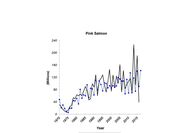
The Alaska Department of Fish and Game released its forecast for commercial salmon harvests this year, projecting a strong run of pinks for Southeast in 2017. If panning out as projected, the news should come as a relief to the region's fishermen after a disappointing 2016 harvest. The report details last year's commercial salmon season, which had come in about 30 percent lower than forecast. Alaska fishermen caught 112,500,000 salmon in 2016, of which 52.9 million had been sockeye and 39...
Alaska salmon fishermen could haul in a harvest that nearly doubles last year’s catch, due to a projected uptick in the number of pinks. An Alaska Department of Fish and Game report on 2017 salmon run forecasts and harvest projections pegs the total catch at 204 million fish. That compares to just over 112 million salmon taken by fishermen in 2016. The catch last season included 53 million sockeye salmon—the fifth largest harvest since 1970—but only 39 million pink salmon, the smallest harvest since 1977. For this year, the forecast calls for a...

WRANGELL – At its rescheduled meeting last week, the City and Borough Assembly approved a bid by the Stikine Inn to purchase adjacent tidelands for less than assessed value. Southeast Properties LLC, which has owned the hotel for a decade, proposed purchasing from the city 5,450 square feet of submerged tidelands and 2,000 square feet of uplands to the north and west of the property's current boundaries. The assessed value of the site was at $101,200, based on estimated fair market value as...
PETERSBURG (AP) – A seafood processing company will stop canning salmon at its facility in the southeast Alaska city of Petersburg this year in response to a growing demand for frozen salmon. Tom Sunderland, vice president of marketing for Ocean Beauty Seafoods, said the company will make more money selling frozen salmon than canned salmon this year. He said the company will focus on freezing salmon at its plant northwest of Petersburg in Excursion Inlet, which has “substantial freezing capacity,” KFSK-FM reported. “And by doing so, the hope is...
Shellfish, sea cucumbers, geoduck clams, seaweeds and biofuels are crops envisioned by a group of Alaskans who are crafting a framework for a statewide mariculture industry expansion. An 11-member task force created last February by Governor Walker has wasted no time advancing its mission to put a comprehensive report on Walker’s desk by next March. The group, which has been meeting regularly, also has attracted wide interest from Alaskans who want to serve on advisory committees as the plan takes shape. The advisory committees include r...
Though last year’s season may have hurt, Alaska fishermen may take some comfort in a disaster declaration made by the Department of Commerce last month. Then-Commerce Secretary Penny Pritzker determined it and eight other commercial fisheries along the West Coast to have been failures, in a January 18 announcement. Low pink salmon runs across the Gulf of Alaska led to a significant drop in 2016 harvest numbers. This declaration provides Congress with a basis to appropriate disaster relief funding for economic assistance to affected c...
More Pacific halibut will be going to market this year due to an overall boost in the harvests for the West Coast, British Columbia and Alaska. The coast wide catch of 31.4 million pounds reflects a 5.1 percent increase, and for the first time in decades, not a single fishing region met with a decline in halibut catches. The International Pacific Halibut Commission, overseer of the stocks since 1923, released the heartening news on Friday. Halibut catch limits are determined by summer surveys at more than 1,200 stations from Oregon to the...
Candied salmon ice cream … poke snack kits … salmon bisque baby food … fish skin tote bags and pet oils – Those are among the more than 20 new items to be revealed this week at the industry’s most popular annual seafood soiree: the Alaska Symphony of Seafood, where the public is invited to taste and vote on their favorites. Now in its 24th year, the event attracts commercially ready entries from major companies to small “Mom and Pop’s” who frequently take home the top prizes. Bambino’s Baby Food of Anchorage, for example, won grand prize for it...

WRANGELL – Trident Seafoods will be welcoming a new manager for its Wrangell plant during the summer's production run. Nick Ohmer was named as the company's selection in a media brief last week. A lifelong resident of Southeast Alaska, in an interview Ohmer said he would be bringing to the job his local knowledge and personal connections with Wrangell's fishermen. Ohmer grew up in Petersburg, and even before fishing alongside those from the neighboring community he grew up with many of them t...

January Public Works rolled out the borough's highly anticipated blue cart recycling program. The borough received $820,117.61 from the annual raw fish tax. Dave Zimmerman was hired as the new Tongass National Forest Petersburg District Ranger. The assembly continued discussing the reallocation of the Kake access road funding. Representative Jonathan Kreiss-Tomkins took part in a budget crisis presentation at Sons of Norway Hall. The visit was the first of many by representatives throughout the...
The start of 2017 marks the 26th year for this weekly column that targets news for and about Alaska’s seafood industry. The goal is to make all readers more aware of the economic and cultural importance of our state’s first and oldest industry. Today, Alaska fishermen and processors provide 65 percent of our nation’s wild-caught seafood; it is also Alaska’s most valuable export to more than 100 countries around the world. The seafood industry puts more people to work throughout Alaska than oil/gas, mining, timber and tourism combined. The bul...
Next year’s pink salmon harvest forecast for Southeast Alaska is anticipating a run statistically on the stronger side, though the numbers may not be particularly optimistic for fishermen still reeling from a disappointing 2016 run. The 2017 report predicts the coming run will fall within in the “strong” range, with a point estimate of 43 million fish and an 80-percent confidence interval. To produce the forecast, researchers adjusted past harvest trends using peak June-July juvenile pink salmon abundance data from 2016. Using expon...
Dashing through the mud, the Democrats did find Two million votes ahead, but yet they’re far behind Trump and Pence on top, with Russia’s help we fear Oh what fun we all can have in an election year! Oh, tweet all night, tweet all day, try to make some sense We better hope those briefings will be read by Michael Pence! Dashing to the bank, with Alaska’s budget holes Our account has tanked, the legislature’s toast Warning bells have rung, the PFD has shrunk Revenue is needed or the ferries will be sunk…. Oh, sales tax, income tax, tax those oil...
Alaska seafood goes to roughly 120 countries around the world and competes in a rough and tumble commodities market. Looking ahead to next year, sales conditions are looking positive for Alaska salmon, with some mixed market outlooks for other main species. Alaska produces more than 65 percent of our nation’s wild caught seafood; seafood also is Alaska’s top export to other countries. Here are some highlights from the Alaska Seafood Industry Updates prepared each fall by the McDowell Group for the Alaska Seafood Marketing Institute: The val...
The Southeast Alaska pink salmon harvest in 2017 is predicted to be in the strong range, with a point estimate of 43 million fish (80% confidence interval: 27–59 million fish). An actual harvest of 43 million pink salmon would be just above the recent 10-year average harvest of 39 million pink salmon. The 2017 forecast was produced in two steps: 1) a forecast of the trend in the harvest, and 2) the forecast trend adjusted using 2016 juvenile pink salmon abundance data provided by the NOAA Fisheries, Alaska Fisheries Science Center, Auke Bay L...
Alaska’s university system is ramping up programs to train the next generations of fishery and ocean specialists - and plenty of jobs await. Since 1987, the College of Fisheries and Ocean Science (CFOS) at the University of Alaska Fairbanks has offered undergraduate and graduate degrees in Fisheries Science, complete with paid internships to help prepare them for positions in the state’s largest industry. “It’s a degree path preparing students for what I call fish squeezers – they’re going to go to work for the Alaska Dept. of Fish and Game, o...
IFQ violations To the Editor: I am writing this letter in regards to the October 27 article “Two Petersburg vessels charged with IFQ violations.” I am the current owner/operator of the F/V Lone Fisherman. It is common for NOAA enforcement reports to only note the date citations were issued, not the date the violation occurred. I understand that this can cause confusion when reporting on information found in the enforcement reports. The violation mentioned in this article occurred prior to my becoming the owner/operator of the F/V Lone Fis...